New data from HMRC shows how much the government relies on just four taxes.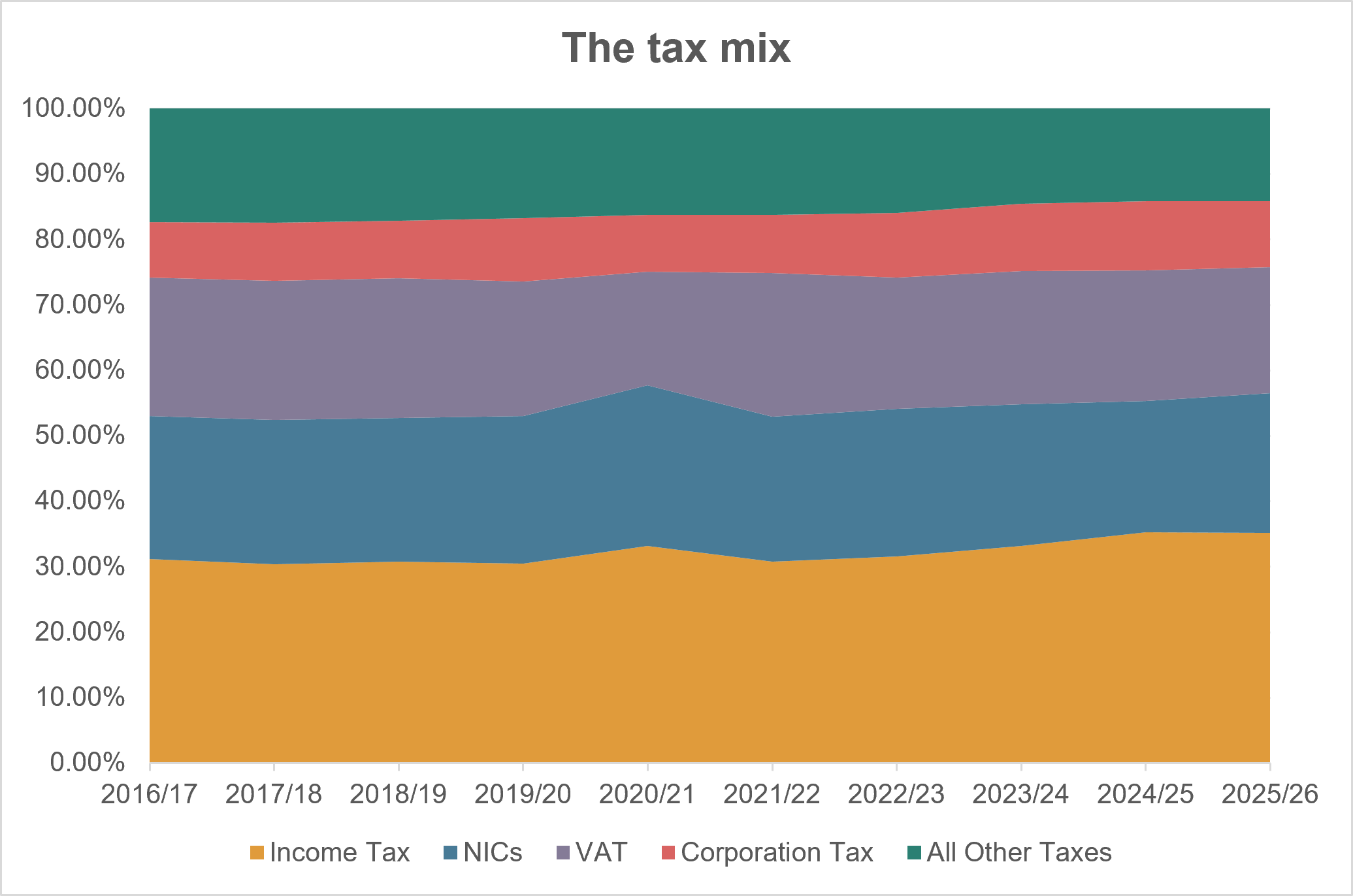 Source: HMRC
The Labour Party went into the 2024 general election with pledges on four major taxes in its manifesto:
“Labour will not increase taxes on working people, which is why we will not increase National Insurance, the basic, higher, or additional rates of Income Tax, or VAT.”
“Labour will cap corporation tax at the current level of 25 per cent, the lowest in the G7, for the entire parliament…”
At the time, the tax promises were seen as politically necessary to counter suggestions that a Keir Starmer government would operate tax-and-spend policies. However, the quadruple tax lock was widely criticised by many economists for the half decade constraint that it placed on the Chancellor in uncertain times.
Fast forward about two years from the publication of that manifesto, and the economists have been vindicated. New data from HMRC, published at the end of April, showed that in the past tax year, income tax, national insurance (NI), VAT and corporation tax accounted for 86% of all tax receipts. That is not surprising – as the graph shows, over the past ten years, the quartet account for more than £4 out of every £5 tax collected.
Despite the manifesto promise, income tax receipts rose by 9% in 2025/26 from the previous year – faster than the growth in prices or the UK economy. That outpacing is due to the freezing of the personal allowance and tax thresholds, dragging more people into tax and more existing taxpayers into higher tax bands.
NI receipts grew even faster – 16.3% up – thanks to the manifesto-challenging changes to the level of employer’s NI contributions. Together, NI and income tax – the two taxes on earnings – accounted for 56.5% of all that flowed into HMRC’s coffers.
The jumps in taxes on earnings contrasted with the growth in the third largest source of tax, VAT, which grew by 5.7%. Corporation tax had even slower growth (4.6%), but that might be because employers claimed more tax relief on those higher NI contributions.
The dominance of the big four manifesto-locked taxes explains why the Chancellor has made so many tweaks to the overall system to raise additional revenue. Be prepared: it is beginning to look like that process will be repeated at the next Budget.
For HMRC’s latest bulletin on tax receipts and NI contributions, visit here.
All data and figures referred to in our news section are correct at the date of publishing and should not be relied upon as still current.